A Solar “Danse Macabre”
Posted by J. Major

Dark prominences swap material on the Sun on March 27-28, 2012. (NASA/SDO)
NASA’s Solar Dynamics Observatory captured a video on March 27 – 28 showing two large areas of “dark” plasma on the Sun’s limb, twisting and spiraling in our star’s complex magnetic field. The southern region bears an uncanny resemblance to three figures swaying to some spooky, unheard music… a real “danse macabre” on the Sun!
Rate this:
2 Votes
A Blue Monday on Mercury
Posted by J. Major

MESSENGER wide-angle camera image of Mercury's surface acquired July 5, 2011.
This latest image from NASA’s MESSENGER spacecraft, now in its extended mission around Mercury, shows a color view of a section of the first planet’s rugged and sun-blasted surface.
Rate this:
4 Votes
The Color of Rhea
Posted by J. Major

Color-composite of Rhea, Saturn's second-largest moon.
If someone were to ask you today what the most heavily-cratered world in the Solar System is, you can’t go wrong with saying “why, Rhea of course!”
(I don’t know why someone would ask you that, but if anyone does you can now consider yourself well-prepared.) 
Rate this:
3 Votes
Enceladus Sprays Its Secrets To Cassini
Posted by J. Major
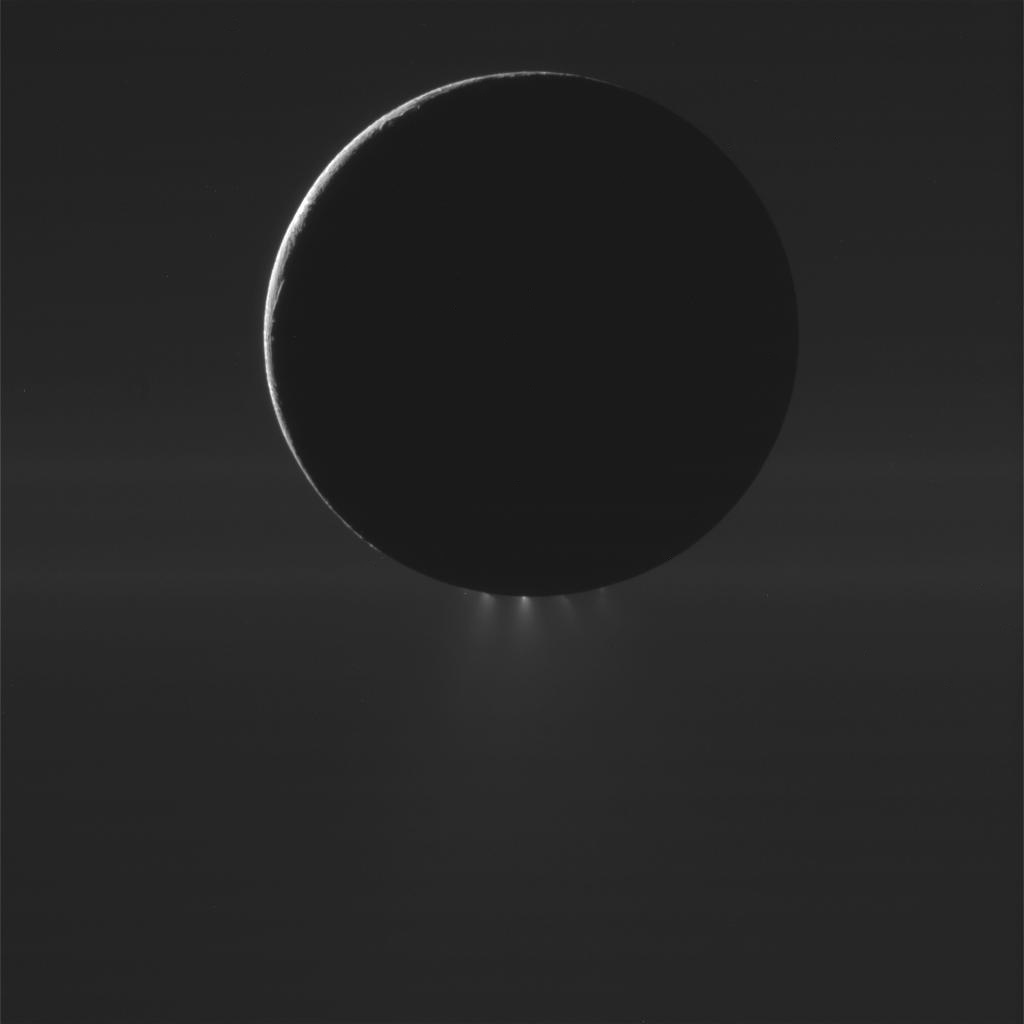
Cassini image of Enceladus from Dec. 2010 showing the moon's icy jets and the hazy E-ring (NASA/JPL/SSI)
Enceladus, Saturn’s 318-mile-wide moon that’s become famous for its ice-spraying southern jets, is on astronomers’ short list of places in our own solar system where extraterrestrial life could be hiding — and on March 27, NASA’s Cassini spacecraft was in just the right place to try and sniff it out.
Why does Cassini team director Carolyn Porco think Enceladus is THE place in the solar system where we are most likely to find life? Find out here.
Rate this:
4 Votes
Posted in Saturn's Moons
A Little Pas de Deux: Tethys and Dione
Posted by J. Major

Saturn's moons Tethys and Dione pass each other from Cassini's point of view. (CLICK TO PLAY)
Saturn’s moon Tethys, its giant Odysseus crater in plain view, passes in front of of the slightly darker Dione in this animation made from several raw images acquired by Cassini earlier this month. Pretty cool!
Rate this:
5 Votes
Pretty as a Picture: Enceladus and Titan
Posted by J. Major

Color composite of Enceladus, Titan and Saturn's rings.
Little Enceladus and enormous Titan are seen on either side of Saturn’s rings in this image, a color-composite I made from raw images acquired by Cassini on March 12, 2012.
Rate this:
4 Votes
Posted in Saturn, Saturn's Moons
Star Lab Makes Suborbital Affordable
Posted by J. Major

Rendering of the Star Lab launch vehicle. (Credit: 4Frontiers)
Star Lab, the next-generation vehicle for suborbital experiments developed by the Florida-based 4Frontiers Corporation, is well on its way toward its first successful flight — and it’s looking for payloads.
I had a chance to interview Mark Homnick, CEO of 4Frontiers, at his office in New Port Richey, Florida. He gave me the run-down on Star Lab and how it will help make suborbital payloads affordable for research institutions, helping them get their experiments off the shelf — and off the ground.
“We’re real, we’re viable, and we have the best deal that I know of… we’ll have the lowest cost and the highest launch rate, anywhere.”– Mark Homnick, CEO of 4Frontiers Corporation
It’s a fascinating venture and it’s going to become a reality very soon. Read the full story here.
Rate this:
What Did You Think?
Is This Comet SWAN’s Swan Song?
Posted by J. Major

SOHO animation of the latest sun-diving comet (LASCO/NRL SOHO team)
A newly-discovered comet is on its way into the Sun… can you spot it in the animation above? No? Read on…
Rate this:
3 Votes
Rugged Rhea
Posted by J. Major

IR/G/UV color-composite of Rhea
Here’s a color-composite image of Rhea, made from raw images acquired by Cassini during a flyby on March 10, 2012. The color is derived from images taken in infrared, green and ultraviolet light.
